“Ahorita, Ahorita” (The Iranian powder keg) – Folha de S. Paulo, November 18, 1978

blank


by Plinio Corrêa de Oliveira


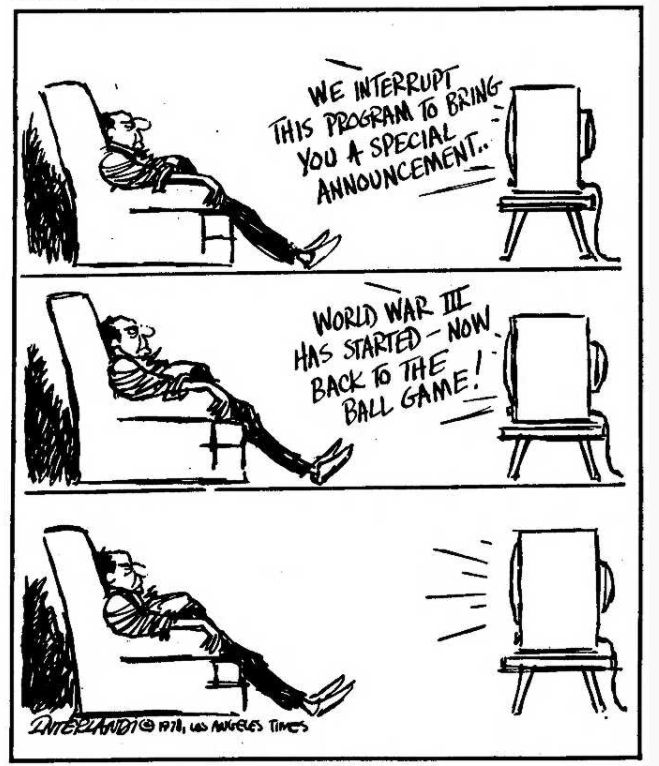
A friend from Kansas City sent me a three-panel cartoon (from the October 13 issue of the Lawrence Journal-World). In the first panel, a man who appears somewhat advanced in age and corpulent sits in an armchair, watching a football game on television. His expression shows attention, but his body is comfortably relaxed. In the second panel, the television seems to emit unusual vibrations. Words appear on the screen announcing that World War III has broken out. The man remains in exactly the same position. In the third panel, the television returns to the game, and the man is still in the same position.
blank


Thus, on this fictional viewer’s quiet afternoon, an event erupted that could suddenly engulf him in an atomic tragedy, ruin his country, and change the course of humanity for centuries. Moreover, it could permanently remove or impose the prospect of worldwide communist domination. None of this affects the viewer’s quiet afternoon, “ahorita, ahorita” (“In a minute, in a minute,” as my friends from Ecuador, Colombia, and Venezuela say). And so he doesn’t even move.
Of course, this mentality is not unique to Kansas or the United States. It extends to large segments of the population worldwide. It also encompasses large areas of São Paulo, including the Higienópolis borough, where I live. It does not creep into me, perhaps because of the meticulous care I take to preserve my mentality from the infiltration of such states of mind.
A characteristic example of this mentality is the attitude of a large portion of public opinion toward the situation in which the newspapers suddenly presented Persia to us.
This country was universally regarded as one of the West’s great barriers to the expansion of communism in Asia. Not only a firm barrier, but also one in a highly strategic position. The Persian coast holds an influential position in navigation through the Persian Gulf and the Sea of Oman toward Suez or the Cape of Good Hope. In short, oil distribution is largely in Persia’s hands.
And were it only distribution! Persia is not only a land barrier but also a mistress of many essential sea routes. It is also a vault holding the treasure of rich oil wells. Other wells in the oil-producing areas of the Persian Gulf are within its reach.
In short, Persia holds the most varied forms of influence in the international game of our oil-dependent world. But the West slept peacefully, believing that all this was well guarded in the strong and skillful hands of Shah Reza Pahlevi.
What would happen if those hands were suddenly seized by the dangerous communists entrenched in neighboring Russia? Numerous Westerners from my country and elsewhere, to whom I had been posing this question for some time, were startled by its impertinence. They answered me with calm authority: That cannot happen. But why? I asked. If Russia strikes anyone it wants in this world, why should the Shah alone be free from its aggression? The answer was always the same: no, it cannot happen. My interlocutors’ attitude did not change even after the coup in April of this year that brought the communists to power in neighboring Afghanistan.
Suddenly, the Shah’s hand sustains the dreaded blow and begins to tremble. The ground beneath his feet begins to move. The air around him, which we had imagined to be clear and diaphanous for millennia, grows cloudy with confusion. An unexpected and cunning coalition of ultra-conservative Islamists and communists throws the country into turmoil. The scepter wavers in the sovereign’s hands. With the scepter, the walls and routes waver, and the precious oil coffers are exposed to all kinds of assaults. In short, world domination is at stake. Depending on the course of events, it is not impossible that a third world war will break out in the medium term, if not sooner.
* * *
What are millions of our contemporaries doing while these events unfold? They behave with precisely the supine indolence of the character in the Kansas cartoon. That is, they devote a little time to a cursory reading of developments that are decisive for the world within the Persian scenario, and then immediately turn their gaze to multiple news reports about disasters, tensions, attacks, and ills that fill contemporary reality, many of which receive prominent headlines usually denied to the Iranian crisis. Then they close the newspaper, concluding, I’m not sure how, that there is nothing new and that the world can be at peace.
However, the same newspapers carry a story that reassures these calm people. Let me explain. The psychological phenomenon is exactly like this. These calm people had forgotten about the Persian case, and upon seeing it change with the establishment of a military dictatorship, they suddenly say they feel reassured.
How can they be reassured if they were already calm? It is better not to ask them this question, because no one is more irritable than those obsessed with tranquility when asked a pointed question. If they are now reassured, was their previous lack of concern only superficial? So, why this display of unreal tranquility?
Furthermore, why were they reassured? Was it because the military would silence everyone, keep the country under Western influence, keep sea routes unobstructed, and keep oil perfectly available? The answer is different.
This minute, “ahorita, ahorita,” everything is fine! That’s enough…
* * *
I am writing on the night of Wednesday, November 8. I don’t know what tomorrow’s newspapers will say, but today’s early editions report that the Shah is counting himself alone. Lacking the slightest public support, the Shah is reduced to a figurehead. However, this figure must be necessary to the Persian psyche. Otherwise, no one would leave him comfortably seated on the ancient “Peacock Throne.” Therefore, he has some popularity there.
What about the military, which has now pushed him aside? How long will they remain in power if it is true that they lack public support, which will continue to be manipulated to a large extent by communists, who can even pull off the supreme pirouette of bringing the most reactionary Mohammedan faction to their side? This question is fraught with uncertainty at a time when revolutionary psychological warfare can, in certain circumstances, be more powerful than machine guns, tanks, and cannons.
Persia remains immersed in uncertainty and confusion. The wall has not fallen, but its stones, as it were, have turned to Styrofoam. The iron vault that guards the priceless springs has become tinplate. Uncertainty reigns along the sea routes…
But for millions and millions of our contemporaries, everything is fine, since, at this moment, at this minute, at this passing second – “ahorita, ahorita” – everything is in order.
So many media outlets, which sometimes reflect the public and sometimes receive its reflection, continue to give more weight to the bitter contemporary nonsense than to the dangerous Persian confusion. That’s how things are.
Before concluding, I realize I need to correct something I said. I described the communists’ juggling act, which managed to enlist reactionary Muslims in the fight against the Shah, as a supreme pirouette. I realize this is nothing compared to another pirouette, this one truly supreme and a thousand times more tragic: having infiltrated the Holy Church of God so widely and so horribly…
Oh, the sadness!
*    *    *
Summary
In Persia, with the Shah’s scepter wavering in his hands, the wall against the expansion of communism in Asia wavers, the oil routes waver, and the precious oil coffers are left at the mercy of attack.
As a result, world domination is at risk, and a third world war is not impossible in the medium term.
What many optimists thought impossible has happened.
Despite this, millions remain in supreme idleness.
Why? Because at this moment, at this minute, at this passing second, everything is still in order.

Contato