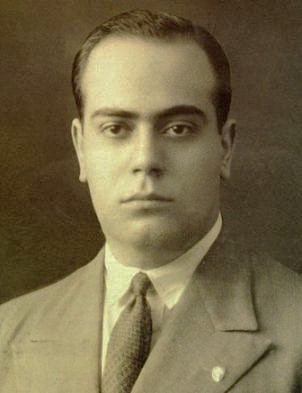
Between the Past and the Future – Legionário, No. 329, January 1, 1939
by Plinio Corrêa de Oliveira
The year 1938 has drawn to a close and now belongs to the realm of history. It is too early to pass definitively detailed judgments on the dramatic events that marked it. However, its general outlines can already be assessed, and this retrospective is of evident use to us, as we prepare, filled with apprehensions and hopes, to laboriously live through 1939.
* * *
On the threshold of 1938, humanity was divided into four major ideological camps: Catholicism, liberalism, communism, and Nazism. Of course, there were intermediate tendencies between these four cardinal points of contemporary thought. However, in addition to being intermediate, these tendencies were provisional by their very nature. They represented merely a stage in the intellectual evolution toward one of those four clear and definitive positions. And for this very reason, they played a secondary role in the topographical survey of our century’s ideologies.
However, while these intermediate positions were really secondary from the doctrinal point of view, they apparently played a dominant or at least very important role, about whose true value countless observers were deceived.
First among these intermediate positions is what has, mistakenly and even sacrilegiously, come to be called “Christianity.” Clearly, in the true sense of the word, there is only one Christianity: the doctrine preached by Our Lord Jesus Christ. By the grace of God, we Catholics know that this doctrine has been preserved pure and complete only within the Holy Church. Therefore, we are absolutely certain that all doctrines of seemingly Christian inspiration outside the Church are in reality forgeries—more or less similar to the original, as the case may be—but which, in any case, are anything other than forgeries.
However, this is not what non-Catholics understand. Sadly, many Catholics have also forgotten the teachings of the Holy Church of God. A “super-denominational Christianity” developed across all Protestant nations and many Catholic countries — a collection of principles common to all religions that call themselves Christian, in the name of which they intended to reform humanity. It is pointless to remind how much was written in Europe and the Americas in 1937 about this “Christianity” and a non-Catholic “Christian civilization” thought to come from it. Whether intentional or not, it was a confusing move that caused a lot of confusion at the beginning of last year.
Amid this profound doctrinal confusion, there was a dual psychological reality: beneath this flexible veneer, many spirits convinced of the infallible and complete truth found only in the Church slipped down the slope and crossed the boundaries of orthodoxy, falling into outright religious indifference, if not into virulent anticlericalism. Others, unfortunately far fewer in number, evolved within the mire of this confusion until they rose and reached full Catholicism (the redundancy is necessary) and finally repudiated their originally ambiguous stance.
In this field, in 1938, the pattern of wavering minds shifting from unstable, fleeting positions to more radical, defined ones became so prominent that we can already see today the failure of what we might call the pan-Christian movement.
* * *
If this happened with respect to the first of the intellectual positions we mentioned, which is Catholicism, the same also happened with the other position, that is, communism.
If there is a doctrine with unclear boundaries, it is that of the left. One only needs to look at the names of French left-wing parties to see this clearly. Radicals, radical socialists, socialists “tout court,” extreme republicans, SFIO, etc.—all of these essentially represent the left. And communism was the abyss into which these various ideological tendencies were flowing.
In France, as everywhere else, the moderate left—socialists, radicals, etc., are becoming increasingly communist, to such an extent that, never in the entire history of socialism, has it moved so quickly toward the far left as in 1938.
We saw grim proof of this just a few days ago in Chile. After its president was elected, a well-known communist agitator from Spain traveled there and held a rally of a clearly subversive nature, attended by 80,000 people. This agitator was the government’s guest of honor at the inauguration of the president elected by the triumphant vote of a genuine “Popular Front.”
The same was true during the great French strike. In short, even among the left, 1938 marked a significant step toward the disappearance of middle-ground positions.
Thanks be to God, because of this, cunning maneuvers to establish a foolish, contradictory, and odious “policy of the outstretched hand” between communists and Catholics were much weaker and less persistent in 1938.
* * *
Let us move from the left to the right.
Two phenomena reflected the same evolutionary process on the right as seen in other sectors: first, the radicalization of Nazism; second, the Nazification of fascism.
Despite everything, throughout 1938, many people in Germany tried to confuse the issue, suggesting that “the devil isn’t as ugly as he’s painted.” They claimed the persecutions of Nazism weren’t as violent or systematic as news reports suggested. Essentially, they argued that if Germany’s religious crisis was real, it was mostly not because of Mr. Hitler but because of the Catholics themselves. If the Catholics had not reacted but instead behaved quietly and meekly, like lambs, and had only softly responded to Mr. Rosenberg’s blasphemies, the Führer—a kind and gentle man—might have felt a twinge of compassion. Mercy could have then flowed from his gentle nature, sparing the Catholics from harsh treatment and giving them a more tolerable situation within the German Reich.
This policy went so far that the Holy Father, already in the last days of 1937, found himself compelled to denounce it with truly supernatural energy. But some veils still lingered in certain eyes. It took Cardinal Initzer’s guidance to show with crystal clarity what Nazism is definitely.
At the same time, Nazism grew increasingly hostile toward Catholicism. With this, the final blindfolds fell from the eyes of the well-intentioned. As for the ill-intentioned, they may still need to walk the road to Damascus. I do not know, however, if the light that illuminated Saul and the fall that shook him—from which he rose again, transformed into Paul—would be enough for certain people…
* * *
While anti-Catholic bias is becoming more openly expressed in Nazi circles, the bias in fascist circles is increasingly Nazi-oriented.
In 1938, O Legionário fought a long and difficult battle against the influence of fascist movements among us. We are and will always be ready to shout “Long live Italy,” alongside those who first shout “Long live the Pope” and “Long live Brazil” with the necessary enthusiasm. In this regard, we love Italy more than anyone. However, because we are friends of Italy, we do not want to confuse it with the mistakes and distortions of fascism.
The Holy Father’s address, which we featured on our front page, perfectly shows how right we were. By confirming our stance, this address marks the peak of all our efforts. A sad peak we would have liked to avoid if only we could say that our worries about Italy are unfounded, and that this glorious, beloved country isn’t really threatened by the clouds we see!
* * *
What happened to liberalism as socialism moved left, fascism to the right, and “pan-Christianity” declined, while a few rare souls soared upward?
It melted like ice cream.
This was the clearest sign of the latest international problems. You don’t have to be a genius to see that England and France are effectively under parliamentary dictatorships in disguise, and that democracy today only truly survives in a few parts of the Americas, where it is clearly shifting to the left.
As for France and England, their major liberal parties are resolutely leaning toward communism and fascism.
As all sides take shape, a clearer movement is forming. It is the ideological merging of Nazism with communism. In our view, 1939 will mark the completion of this merge. From this monstrous union, a movement will emerge that will be the “nec plus ultra” for Satan’s plans.
Could we be wrong? Maybe. In any case, “L’Osservatore” [Romano] itself has been pointing out this march of Nazism toward the left.
This means that all errors are flowing into the same abyss, and that all the forces of the century are uniting.
Against whom?
The mystical Bark of St. Peter rides this stormy sea. Mysterious waves are gathering around it, soon to turn into a massive storm.
However, we do not fear. While keeping a watchful eye on the crested waves teeming with mysterious monsters, we still find our bearings in the stars.