|
Plinio Corrêa de Oliveira
How can the World hate Him who went about doing Good?
“Catolicismo”, April 1960 (*)
|
|
|
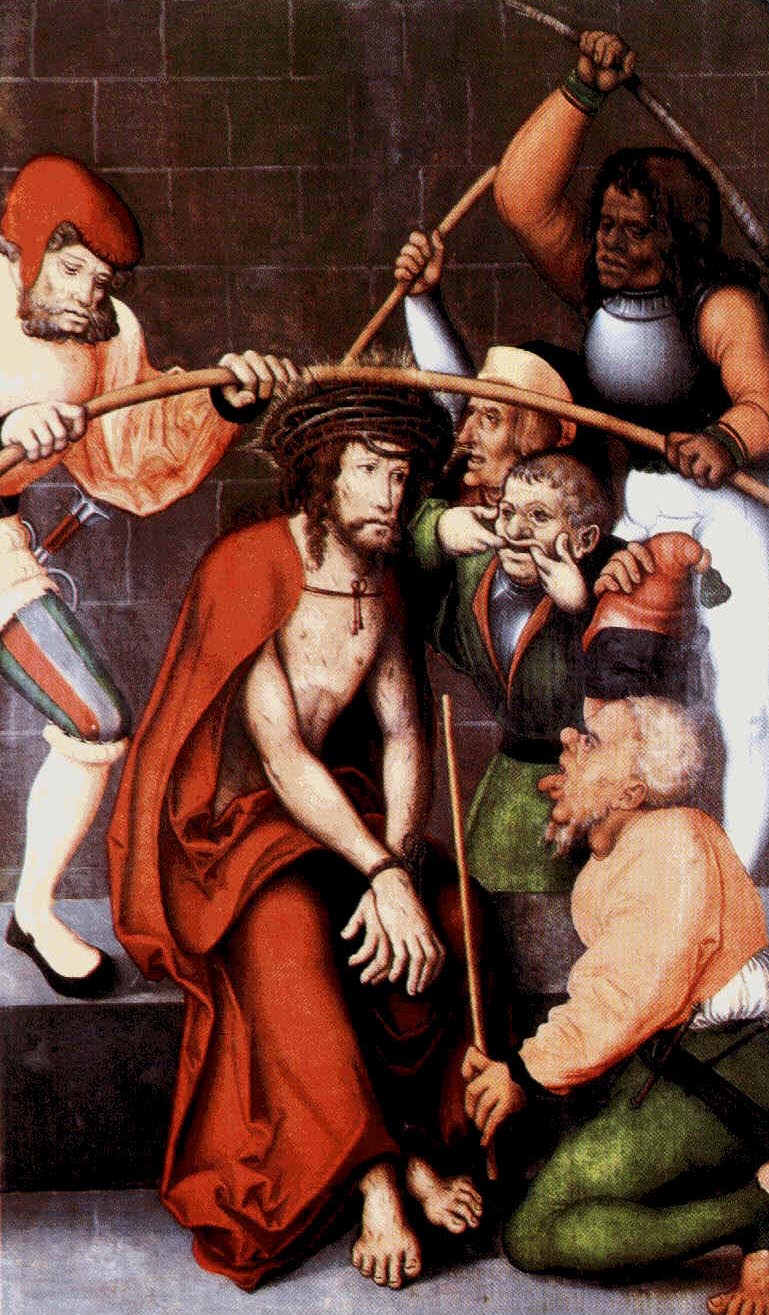
HERE we see a picture by Lucas Cranach the Elder (1472-1553), The Crowning of Thorns, preserved in the Museum of Ghent, Belgium. Five men gather around the Divine Redeemer, tied up and mockingly dressed in purple. In the foreground, a man offers Him a stick as a scepter, and at the same time, in a satiric greeting, tips his cap and sticks out his tongue. At His side, another stretches his mouth in an attitude of jeering. The others in the background try to force an immense hat of thorns, like a crown, on the Savior's adorable head. The Son of God shows signs of physical pain, but above all, of intense moral suffering that surpasses His bodily torment and completely absorbs the Divine Victim. One would say that Our Lord suffers because of the deep-seated hate of these wretched tormenters but that this hatred is nothing but the threshold of an immense ocean of rancor which extends far beyond, to the ends of the horizon. It is to this ocean that the gaze of Jesus extends in sorrowful meditation. This picture by Lucas Cranach focuses on a very important aspect of the Passion: the contrast between the infinite holiness and ineffable love of the Redeemer and the unfathomable vileness and implacable hatred of those who tortured and killed Him. In it, the irreducible opposition between the Light— "erat lux vera" (John 1:9)—and the children of darkness, between truth and error, order and disorder, good and evil, becomes obvious. "Popule meus, quid feci tibi? Aut in quo contristavi te?" (O my people, what evil have I done you? Or in what did I sadden you?) These words, which the liturgy of Good Friday puts on the lips of Our Lord, are in the very center of the topic we have just enunciated. Although it may be censurable for a man to hate one who wrongs him, it is not incomprehensible. But how can a man hate someone who is good, who did good to him? This problem is almost as old as mankind. Why did Cain hate Abel? Why did the Jews persecute and not rarely kill the prophets? Why did the Romans persecute the Christians? Later on, why was so much blood of martyrs shed by the Protestants, by the French Revolution, by the Bolshevik Revolution in Russia? More recently, how can one explain the hatred of the communists in the Spanish Civil War, in the persecutions in Mexico, Hungary and Yugoslavia, the land that in 1960 wept over the death of Cardinal Stepinac? We ask: why was he so hated? We well know that these questions, so worded, will seem to many a bit oversimplified. The hatred of the enemies of the Church was not always gratuitous. At times, on the part of Catholics as well, provocations and excesses were not lacking and caused reactions. Indeed, there were a certain number of cases in which mistakes and misunderstandings provoked violence. Then there were martyrs, not because the Church was duly known and nonetheless hated as such, but precisely because she was unduly unknown or disfigured. We deny none of this. But to reduce the hatred of darkness against light, of evil against good, to these causes is indeed to singularly oversimplify the matter. This is seen very clearly in the Passion. * * * WE observe at the outset that, although Catholics can have faults, Our Lord had none. Whether regarding the depth and the form of His preaching; whether regarding the tact and the opportunity with which He taught; whether still regarding the edifying character of His examples, the apologetic value of His miracles, and the most holy and striking aspect of His Person, there can be no doubt. He gave no pretext to any legitimate objection or to any solid complaint. On the contrary, He only provided occasions for people to adore Him and follow Him. However, He was also hated, but hated even more than His faithful throughout the ages. How can this be explained? In the children of darkness there is a hatred which is precisely turned against the truth and good. It is useless then to wish to attribute everything to a mere set of mistakes. They have existed, but they do not resolve the problem. * * * SOMEONE might say that this hatred is quite simple to explain. God's Law is austere. Whoever does not want to subject himself to the sacrifices inherent to its observance disobeys and easily revolts. Revolt in its turn begets hatred, especially hatred against truth and goodness. Thus, everything is explained. We do not deny that in the generality of cases the root of hatred against God lies therein. But to understand the problem well, it is necessary to go slowly. All sin is an offense against God. But there are some sinners who retain some sadness for the evil they practice and a certain admiration for the good they do not practice. Hence, they regret the life they lead, they advise others not to follow their example, and they honor those who practice good. On account of this humble attitude, Our Lord often grants them great graces and they return to the way of salvation. Had only these sinners existed in Israel, I believe that Jesus would not have been persecuted and, much less, crucified. If Cain were of this number, he would not have killed Abel. If all the sinners in history had been like these, history would not record the horrible persecutions that were mentioned a little while ago. What moves the sinners who constitute the ungodly souls of the persecutions against the Church? That is the problem. * * * THE saddened and shameful sinner we spoke of cannot properly be called wicked. If he becomes so steeped in sin that he comes to lose his sadness at committing it and his admiration for those who practice virtue, he will slide into wickedness. Then a first-level wickedness will be born, so to speak, that will redound in indifference for religion and morality. Only personal interests matter to the wicked of this genre. For him it is the same to live in a good environment or a bad environment. As long as he makes money and has his career or has fun, anything will do for him. Evidently, this wickedness is very censurable. All those in Jerusalem who attended the Passion as mere curiosity-seekers were culprits of this. So are those throughout history who think they have the right to witness the struggle between the children of light and the children of darkness without taking a stand, like an egoistic "third party." Even this type of people alone, however, would not have committed the deicide. * * * BUT there are souls that go farther. Moved by sensuality, pride or some other vice, they take malice so far, they are so identified with sin, that they feel good only when they satisfy their bad habits. They put up with nothing that censures or even merely disagrees with their behavior. Thence arises a hatred for the good and for Goodness, for the paladins of truth and the very Truth, which gives them as it were a negative ideal. Voltaire expressed this very well in his motto "écrasez l'infâme" —crush the infamous one (the "infamous one" being the Word Incarnate!). To make this a constant aspiration, the "ideal" of a life, behold, this is the quintessence of impiety. People like this have all the requisites to plan, plot and execute persecution. Had people like this not existed in Israel, Our Lord would not have been crucified. * * * GOD does not deny His grace to anyone. Evil men like these can also convert, and with all their heart. Nevertheless, it is fitting to add that, until they do so, they already have here on earth the most important characteristic of those damned to hell. Actually, it is generally thought that all the damned would flee to heaven if they could. Not true. They hate God so much that, even if they could free themselves from their imprisonment in eternal fire, they would not do so if for this they would have to render an act of love and obedience to God. Such is the force of this hatred. And it is in light of this that one understands well what we would call a second-level wicked man. This refined impiety was the moving force that animated the Synagogue in the revolt against the Messias. It has moved the fight of the wicked against the Church and against the good Catholics throughout the ages. * * * CHILDREN of darkness, these are the wicked. Prince of darkness, this is Satan. What relationship is there between the two? Judas was a son of darkness. The Gospel tells us that the devil entered into him (cf. Luke 22:3). We know through the faith that evil spirits "roam throughout the world seeking the ruin of souls." When the devil is able to accomplish his complete work in a soul, he takes it to this state of impiety. Reciprocally, such a soul is an open field for the devil's temptations. It is easy to see, then, that such wicked men are the best aids of hell in the fight against the Church. * * * LORD, in this moment of mercy, in which we consider Thy holy Body shedding Thy redeeming Blood all over, we beseech Thee, through the infinite merits of this same precious Blood, and through the tears of Thy Mother and ours, keep us very, very far from any impiety: separated from Thee let us never be, with all our heart we beseech Thee. Wherever the wicked persecute the children of light, and most especially in the Church of Silence, be, O Lord, the strength of the persecuted, not only that they may not die, but that they may raise up, join together and crush Thy adversary. We ask Thee this through the Immaculate Heart of Mary. And as at the last moment Thou didst still promise Paradise to a criminal, Lord, by the merits of Thy agony we beseech Thee, in union with Mary, that Thy mercy come upon even the hidden dens of impiety, so as to invite even Thy worst adversaries to the ways of virtue. Still through mercy, Lord, confound, humiliate and reduce to complete impotency those who, refusing the most extreme appeals of Thy love, persist in working to destroy Christian civilization and even—as if it were possible—Thy mystical Bride, the Holy Church. (*) TFP Newsletter, Vol. 5, No. 12, 1992.
|
|