|
Plinio Corrêa de Oliveira
The sphinx souls
"Diario de Las Américas", Miami, 3-09-1976
|
|
|
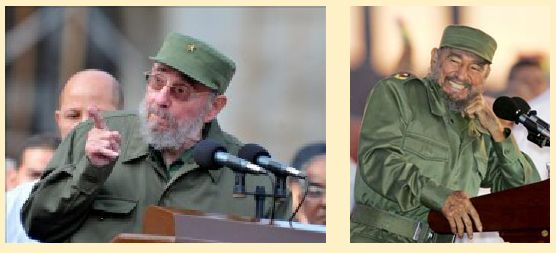
I – FIDEL CASTRO, IMPERIALIST ADVENTURER 1. Exported guerrilla warfare all over Latin America. That imperialist adventure failed because of the allergy of our rural and urban populations to Communism. 2. In spite of this, the American nations permitted his return: in 1975, the end of the blockade of Cuba. Now the only thing left is for her to be admitted as a member of the OAS. 3. Nevertheless, Cuba continues to be a poisonous spike, stuck into the flank of the United States, which Moscow can twist at any moment. 4. Cuban guerrillas at the service of Russia are agitating Africa and Asia Minor. II - HOW WAS IT POSSIBLE FOR CUBA TO BE REINTRODUCED INTO THE PEACEFUL ASSOCIATION OF NATIONS? 1. "Confident" souls believe that the Communists of Cuba, like those of Russia and China, are no longer the aggressive bullies they used to be… 2. What happened in Cambodia, Vietnam, and Portugal is a categorical refutation of this thesis. 3. But the "confident" souls smile once again: the conversion of the Communists to pacifism is a fact known by intuition, it does not require proofs… III - CONTRADICTIONS AND MYSTERIES 1. How is it possible to continue believing in this pacifism in the face of the recent Cuban intervention in Angola? 2. The word "scandal" is colorless and insufficient to describe this mystery. 3. It is necessary to make a supreme effort to unmask this family of sphinx souls who are playing the game of international Communism. * * * No Latin American — and I believe no North American either — has forgotten that some years ago Castro's Cuba exported guerrilla warfare to the whole of South America. And the reaction to this undertaking also has not been forgotten, for without the allergy to Communism of almost the whole of the rural populations and the great majority of the urban masses, Marxism would have come to dominate all the vast regions between the Caribbean and the South Pole, between the Pacific and the Atlantic. This Castroist endeavor — which could be considered one of the most typical imperialist adventures in the post-war period — provides clear lessons which are still present in the memories of the peoples of the Americas. Nevertheless, what do we find happening? In the Fifteenth Consultative Conference of the OAS (Organization of American States) which met in Quito, Ecuador in 1974, Cuba came very close to being the full beneficiary of the following gifts: the absolution of the sins of its Communist leaders, the granting of an amnesty from all the blockades and sanctions to which it was subjected, and the reintroduction with complete honors and advantages into the family of American nations. To say simply that Cuba was one step away from winning this advantageous and clamorous political victory is to fall short of the reality. As many as a dozen nations voted in favor of the admission of Cuba. Only three pronounced themselves against it. Six maintained neutrality. In the loose and thoughtless atmosphere in which the non-communist world lives, it is well to note that the "defeat" of Cuba at the Quito conference was really a half-success that left everything prepared for a complete victory at another OAS meeting. This finally came at the Sixteenth Consultative Conference of the OAS, held in July of 1975 at Costa Rica, when, by 16 votes to 3, with 2 abstentions, the blockade was in fact suspended, leaving each country free to resume diplomatic and economic relations with Cuba. Now the only thing that remains is for Cuba to be readmitted as a member of the OAS. This is merely a step, the automatic consequence of the previous successes. * * * Intermingled with this complex of events is a simply shocking contradiction. It is one of those obvious and grotesque contradictions that will make the contemporary West the laughing stock of History as long as the world exists. In fact, in the case of Castro's Cuba (sometimes the instrument of Peking and sometimes of Moscow), the "dossier" shows that its activities have not been limited to spreading guerrilla warfare in the immense regions of South America. In 1962 that island served, in the hands of Russia, as the powder train which almost set fire to the whole world. And it continues to be a poisonous spike sunk into the flanks of the United States. This spike — and we allude in this way to all the tactical and logistical advantages that the geographical position of Cuba confers upon it — can be twisted at any moment by Moscow into the flesh of the Southern coast of the United States. As if all this were not enough, Fidel Castro and his henchmen must be mentioned as those responsible for the agitations that have been churning almost all of Africa for ten years now. Thus it is that Cuban guerrillas, supported by Russian technicians and armament, have been spreading Communist or para-communist revolutions in Algeria, the Congo, Guinea, Guinea-Bissau, Somalia, and Zaire, not to mention Yemen, South Yemen, Oman, and Syria. In the face of the enormity of these actions, constituting as they do so many other transgressions against the most basic norms of international relations, how was it possible for Cuba to be reintroduced into peaceful association with so many nations of this hemisphere? Since Cuba is the most blatantly aggressive of the American nations, how could it even happen that it was practically invited to take its seat in honor and comfort among its peaceful sister nations? * * * It would be a waste of time to begin digging in the secret files of the various state departments to try to answer this question. Any American from Alaska to Patagonia need only look around himself a bit, and he will find people in favor of the readmission of Cuba into the OAS. If we ask any one of these advocates of Cuba how they can maintain such an immensely contradictory position, the answer will always be the same: a vague smile accompanied by jargon or confused prattle insinuating that the Communists of today are not what they used to be. In our days they have become meek observers of the good norms of international relations. So then, we can live in peace with them. This generic affirmation holds for Russia and for China and for Cuba as well. Needless to say, the events in Cambodia, Vietnam, and Portugal furnish material for the most categorical refutation of this thesis. If one of us anti- communists puts forward these three scandalous adventures of Red imperialism in order to silence those who optimistically count on the Communists being converted to pacificism, he will receive as an answer a second smile. This second smile be lightly disdainful, insinuating to us that the conversion of the followers of Marx to pacificism is an intuitive fact that can only be perceived by the most intelligent. This arrounts to closing the argument by calling us idiots. This is hardly a pacific way to argue for those who believe at al costs in the present-day Communist pacifism. * * * I am not writing this article to heap accusations on Castro's head. These accusations are already piled upon him so notoriously that such a work would be superfluous. My intention herein is to analyze the disconcerting mentality of those who want Communist Cuba to be treated as a peaceful nation on the diplomatic level. And if I have called to mind the activities of Castro, it was only done in order to point out that those who favor an incautious and confident attitude in relation to Cuba have fallen into an enormous contradiction. This contradiction is so immense, so out of proportion to the usual aberrations of the human spirit, that it takes on the character of a mystery. This mystery is even deeper and denser than that of the Egyptian sphinxes. By what artifice of propaganda has Communism managed to raise up this inexplicable family of souls who trust in its innocence. * * * The matter does not stop here. Those who in 1974 believed so gratuitously and obstinately in the conversion of the Communists to pacifism, have a new scandal before their eyes. It is the intervention of Cuban troops in Angola. This intervention will perhaps be followed shortly by others — for example, in Rhodesia or South Africa. In the face of this fact, for which the word "scandal" appears colorless and insufficient, there are still those who continue to have an "intuition," who go on smiling and trusting. This has gone so far that I will not be surprised if the next meeting of the OAS accepts Cuba. Possibly between now and the meeting, Fidel Castro will try to broaden his action in Panama, Puerto Rico, Colombia, or Venezuela. None of this will shake the grinning friends of Castro's Cuba out of their somnambulant "intuition" and obstinate "confidence." And there the mystery remains to defy the men of today, to disconcert weak anti-communists; and to stimulate authentic anti-communists to a supreme effort to unmask this family of sphinx souls at the service of the communization of the world before the eyes of the sleeping and imbecilized West.
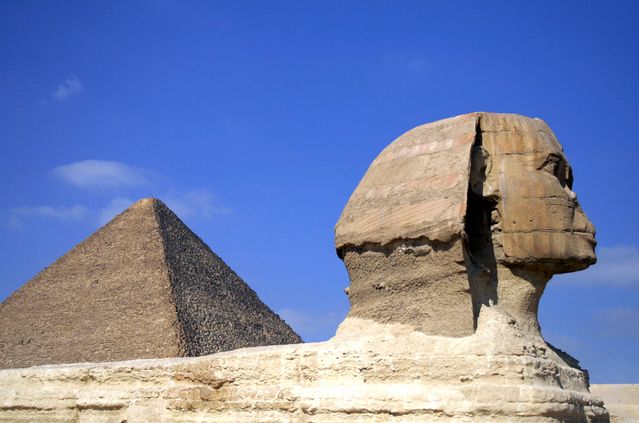
The Sphinx of Giza
|
|