|
In Spain
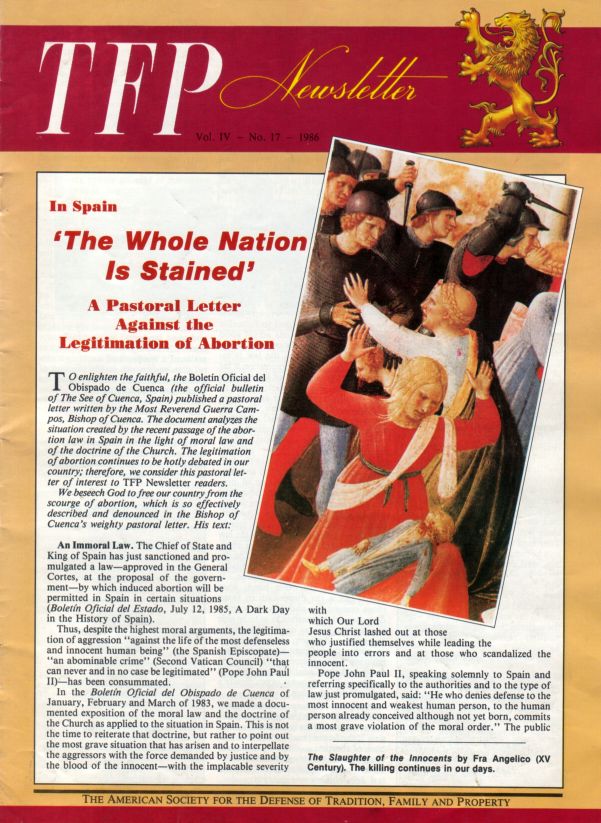
“The Whole Nation Is Stained” A Pastoral Letter Against the Legitimation of Abortion
“TFP Newsletter”, Vol. IV – No. 17 – 1986
|
|
|
To enlighten the faithful, the Boletin Oficial del Obispado de Cuenca (the official bulletin of The See of Cuenca, Spain) published a pastoral letter written by the Most Reverend Guerra Campos, Bishop of Cuenca. The document analyzes the situation created by the recent passage of the abortion law in Spain in the light of moral law and of the doctrine of the Church. The legitimation of abortion continues to be hotly debated in our country; therefore, we consider this pastoral letter of interest to TFP Newsletter readers. We beseech God to free our country from the scourge of abortion, which is so effectively described and denounced in the Bishop of Cuenca's weighty pastoral letter. His text:
An Immoral Law The Chief of State and King of Spain has just sanctioned and promulgated a law—approved in the General Cortes, at the proposal of the government—by which induced abortion will be permitted in Spain in certain situations (Boletin Oficial del Estado, July 12, 1985, A Dark Day in the History of Spain). Thus, despite the highest moral arguments, the legitimation of aggression "against the life of the most defenseless and innocent human being" (the Spanish Episcopate)—"an abominable crime" (Second Vatican Council) "that can never and in no case be legitimated" (Pope John Paul II)—has been consummated. In the Boletin Oficial del Obispado de Cuenca of January, February and March of 1983, we made a documented exposition of the moral law and the doctrine of the Church as applied to the situation in Spain. This is not the time to reiterate that doctrine, but rather to point out the most grave situation that has arisen and to interpellate the aggressors with the force demanded by justice and by the blood of the innocent—with the implacable severity with which Our Lord Jesus Christ lashed out at those who justified themselves while leading the people into errors and at those who scandalized the innocent. Pope John Paul II, speaking solemnly to Spain and referring specifically to the authorities and to the type of law just promulgated, said: "He who denies defense to the most innocent and weakest human person, to the human person already conceived although not yet born, commits a most grave violation of the moral order." The public Powers in Spain, contrary to their primary duty, deny protection to the life of the weakest. Furthermore, they facilitate this homicidal act with public means. For this reason we are not dealing merely with depenalization. We are facing the legalization of a crime. It is of no use to invoke the pluralism of beliefs nor to conform oneself with a simple manifestation of opinions as if all were an amiable literary discussion. Because, according to the pontifical teaching, "the life of a child prevails over all opinions." It prevails over all constitutions. It prevails, a fortiori, over all propagandistic subtleties. It prevails over all diplomatic simulations. To say that the law is only permissive, and not obligatory is a cruel fallacy, for it is a permissive law that permits the killing of innocents and deprives the victims of the unjust aggression of defense. It legitimates a crime. The restriction of the law to certain conditions does not modify its moral standing, for in no case is voluntary abortion permissible. Moreover, moral judgment is not restricted to formalist appearances. It confronts actual good and evil. And it is notorious that in the social context in which the law is introduced, its abortionist projection is far greater than the content of its text. The law does not serve as an expression of penal benignity, but rather as an incentive and a justification for it. The decision of the Constitutional Tribunal evidenced the omission of guarantees on the part of the legislators. Many statements by government officials (some very recent and related to the decision) and those by columnists and people who with impunity boast of promoting and carrying out abortions demonstrate that those who hope to take advantage of the law disregard the "official" conditions, which they merely take into consideration, and hail the law as a door to obtain impunity for abortion in many other conditions. The desire to "protect" the "unborn child," demanded by the Constitution, is weakened. On the other hand, what stands out is the disposition to favor those committing abortion, by expanding some of the motives so as to be able to use them even as universal pretexts. In greater derision, the same law authorizes the pregnant woman to abort, ignoring the guarantees that the law sets down and the Constitutional Tribunal demands! This amounts to practically a free rein for abortion. In any case, the large number of abortions, together with the aggravating factor of the monstrous commercial utilization of the fetuses, makes the moral problem of abortion qualitatively and quantitatively the most grave in today's world—more so than terrorism. And this law does nothing to remedy it. Opposition to the Law Must Not Cease Opposition to other laws ceases at the moment they are promulgated; they are respected even when they are not satisfactory. However, this should not be the case for this law. The worst and the most intolerable effects will begin after its promulgation. For as long as the law exists, it must be denounced and repudiated, and its revocation must be demanded. People and institutions that wage noisy, interminable battles in defense of lesser interests show themselves very solicitous in keeping silence about this matter. They become shameful accomplices in the conspiracy of silence, as if the issue were closed and better forgotten. But that silence conceals a slaughter of innocents. While the blood flows and the infants are torn to pieces, some find it very convenient to attempt to stifle the voices of protest by manipulating with cynical white-gloved elegance terms such as "tolerance," "peaceful coexistence," "moderation," and "regulation of an existent reality." What does all this mean when crime is being authorized and facilitated at the expense of the weakest and most innocent? What significance does such false rigmarole have, except to act as of a symptom of a rotting society? Can such words be the reaction of a healthy organism? Can one admit the sincerity of such language? When those who speak thus feel themselves to be victims of aggression, do they accept that others use such language? It Is Immoral to Cooperate in the Enforcement of the Law Cooperation in legalized abortions is gravely immoral. As the Pope warned in Spain, it is immoral to provide public and private means to cause the death of defenseless victims. The State has no authority to oblige physicians and nurses or any employee to such cooperation, which they should in conscience deny. An order by the public power to that effect would not only be erroneous, but also radically null and perverse. In face of it, one would have to say with the Apostles: "We ought to obey God, rather than men." The King says: "I order all Spaniards, both private citizens and authorities, to observe this organic law and see that it is observed." This mandate and the content of the law itself only demand the obedience of the judicial powers in the rescission of penalties, because, among other reasons, the judicial powers are deprived of the faculty to impose penalties. Any mandate that implied cooperation would deserve refusal. When the law was made known publicly, one Spanish bishop on the Conference board wrote: "It is not licit to cooperate in the writing, in the promulgation or in the enforcement of a law that is clearly adverse to the primary norms of human morality." The Moral Ruin of Society When the Spanish Constitution says "All have the right to life," it makes no distinctions. That right must be protected. It is strange that the Constitutional Tribunal interprets this to mean that some have that right, while others do not. It is also strange that while the Constitution excludes the death penalty for murderers and other offenders during peacetime, the Tribunal authorizes the death of innocents in certain cases. But the problem does not lie in the interpretation. The real problem is that if the Constitution, in its concrete juridical application, permits some to be put to death, then not only the government officials, but also the fundamental law itself, obviously leave the weakest and most innocent without protection. (And regarding this: Have the government officials who, somehow supported by members of the clergy, deceived the people—soliciting their votes while assuring them that the Constitution did not permit abortion—anything to say to us? Will anything they say now prevent the slaughter that has been legalized?) As long as this situation persists, the foundations of society are fearfully threatened. In Spain, the Pope warned that once the death of an innocent is legitimated, "the very foundation of society is undermined." The foundation is undermined. Therefore, the error of those who treat this issue as an isolated fact is patent. To absolutely repudiate abortion, one is obliged to consult anew the moral preaching on the structure of society. This obligation is equally incumbent upon the Crown. It is contradictory to accept as good a system that legally has unacceptable effects. It is impossible for someone in good conscience to tranquilly install himself in such a system without doing what is necessary to orient it, and to detach himself from responsibilities that cannot be shared. But this is not the moment to develop this matter of such scope. Those accountable should at least open their eyes to see that their conduct undermines their own foundations. It is suicidal. Because they will continue to attempt to secure their own defense against aggression. And if this is just in itself, how could it be equitable for them to leave those who are most in need without defense? Can those supporting the law of the strongest at the expense of others maintain any credibility when they appeal to moral values? Did they not lose all moral authority to claim respect for their own lives and to protest against terrorism? In certain circumstances, the terrorists apply the same moral criteria to their interests that those who legitimate abortion apply to the other interests. Even now, all responsible people and organizations have united in indignation, in which they will remain while the clamor, though suffocated, of the innocent victims continues. It is necessary to stress the responsibility of those who, while repudiating abortion and the lack of protection for its victims as absolutely immoral, enabled or still enable those guilty of this crime to enjoy the support of Catholic votes. Where in certain ecclesiastical circles were the so-touted "prophetic denunciation," "the voice of those who have no voice" and "the critical conscience of society"? Where is the John the Baptist who tells the powerful: "It is illicit for you to do this!"? Have the prophets become complacent courtiers? Those who "legitimated" the vote on the abortion law do not escape responsibility, whatever their own vote. Did they not decline to vote on other laws so as to not become accomplices in their passage, "even in a passive way"? As long as it is legal to kill those who live in the wombs of their mothers, the whole Nation is stained—some by action or complicity, others by omission. Their nationhood stands under interdict. Especially damaged is the Crown, the traditional succor of the weak and of the natural law. How lamentable it is that this succor has been interrupted at the expense of the most defenseless, whether because the institution wants to come to their aid but cannot, or because it can but does not want to. This wound can only be closed—and this not without humiliation—with the revocation of the law, the repulsion of homicidal conduct, and the structural cleansing referred to before. The law was promulgated in July, the month in which the feast of Saint James the Apostle is celebrated. On this feast the Spanish Nation makes one of its two annual offerings to its Patron Saint. These offerings were instituted over three centuries ago: one by the Cortes, the other by the King. Suppressed in 1931, they were reestablished in 1937. Can a nation make offerings to an Apostle of Christ and at the same time immolate infants on the altar of Moloch? Saint Paul the Apostle is fast upon our heels and cries out: "What concord hath Christ with Belial?" "What agreement hath the temple of God with idols?" "You cannot drink the chalice of the Lord, and the chalice of devils" (1 Cor. 10:21 and 2 Cor. 6:15-16). Catholics and Their Relationship to the Church The situation of Catholics responsible for abortion, in relation to the Church, is defined in two levels: a) Canon 1398 in the Code of Canon Law establishes for the whole Church: "A person who actually procures an abortion incurs a latae sententiae excommunication" (that is, by the very fact of committing the crime). The excommunication includes, among other things, the prohibition of receiving or celebrating the sacraments and of participating ministerially in any act of worship. Given the conditions of imputability, this excommunication is incurred by all those who procure, perform or cooperate in the performance of an actual abortion: those who induce the mother; those who provide or prepare the means to perform it; the mother who wants or allows it to take place; its physical authors, the doctors, technical attendants and other collaborators; those who supply clinical facilities and the means of other sanitary and economic institutions. Note that if the abortion is not effected excommunication is not incurred, even though the ineffective attempt has the same moral malice. b) Catholics who favor abortion and are in positions of authority or public office obviously incur this same excommunication to the degree that they cooperate in the performance of a concrete actual abortion. Sometimes it cannot be determined whether the action of the authorities is responsible for a concrete, actual abortion, or whether this action is restricted to fostering the general possibility and facilities for its performance. In this case the excommunication would be doubtful. But there is nothing doubtful about their tremendous moral responsibility, which is ordinarily greater than that of the executors; neither is it doubtful that they deserve public rebuke and spiritual penalties even should they not be automatically incurred. Certain statements by ecclesiastics regarding this point unduly disorient the faithful because, even though the statements are true, in context they necessarily ring of an attenuation of responsibility or of a benevolent interpretation of actions that, on the contrary, must be denounced as fits their enormous gravity. Three opportune examples show us how it is necessary to avoid equivocations: First example. Someone who were to proclaim "He who kills the King, the Queen and the Royal Family does not incur excommunication" would be saying a truth. Nevertheless, everyone would rightly concede that such a proclamation would be imprudent, ambiguous and intolerable. Second example. No one would say that the crime of a mother who, with imputable acts, were to murder all the members of her family, or of a doctor who were to do the same to tens of hospital patients would be a lesser crime than an abortion, even though the latter incurs excommunication while the former does not. Third example. This example brings us closer to the practical treatment of our case. The Code of Canon Law does not establish an automatic penalty for "the faithful who belong to Masonic associations," but the Holy See expressly declared that "they are in grave sin and may not receive Holy Communion." The authority of the Church can determine canonical punishments in different ways. No authority of the Church can modify moral culpability or the malice of scandal. Sometimes attempts are made to elide the higher responsibilities, as if the intervention of the public powers amounted to no more than acting as witnesses, record keepers or notaries of the "public will." They will see. God is not deceived. One thing is for certain: the Chief of State, upon promulgating the law for Spaniards, does not say, "I attest." He says expressly, "I command all Spaniards to observe it." Those who implanted the abortion law are conscious and contumacious authors of what the Pope calls "a most grave violation of the moral order" with all of its charge of harmfulness and social scandal. Let implicated Catholics see whether they are affected by Canon 915, which excludes from Communion those who obstinately persist in "manifest grave sin." Can they allege any attenuating circumstance that will free them from guilt in their decisive cooperation with evil? Does such a circumstance exist? If so, it would be most rare and, in any case, transitory. And let them remember that the representatives of the Church cannot degrade their ministry by raising the mere social or diplomatic relationship to the comunicatio in sacris. The general rule is clear. Catholics in public office who promote or facilitate by laws or acts of government—or in any case protect juridically—the practice of the crime of abortion will not be able to escape the moral qualification of public sinner. They will have to be treated as such—particularly regarding the reception of the sacraments—until they repair, to the best of their abilities, the most grave evil and scandal they have caused. July 13, 1985 Jose, Bishop of Cuenca
|
|