|
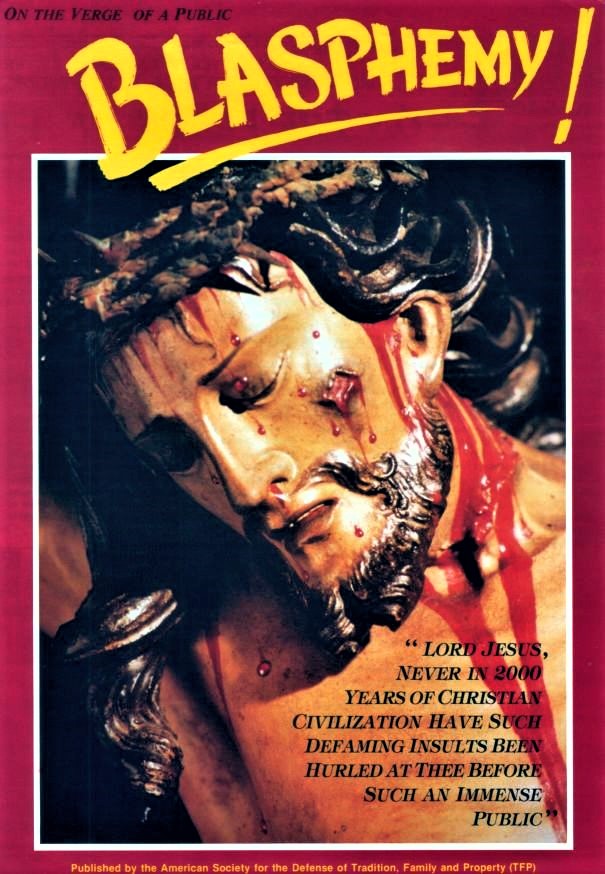
On The
Verge Of A Public
|
|
|
Published in the “New York Times”, August 11, 1988 in both the national and northeast editions An Open Letter to Universal Pictures Concerning the Film "The Last Temptation of Christ"
Gentlemen: FOR SOME TIME NOW, reports have circulated about the production of the film, The Last Temptation of Christ, based on the well-known novel of Nikos Kazantzakis which we regard as sacrilegious. This has generated controversy among Americans across the nation because of both the content of the proposed film and its promotion. In response to the early release of this film, the American Society for the Defense of Tradition, Family and Property (TFP) believes it a duty to present an analysis of certain aspects of the controversy. We will not attempt to summarize here everything that has been said about the film. We can only speculate about what the final version of the film contains. It will suffice to mention just a few of the many shocking accounts published by the press: 1. "This Jesus is a carpenter who builds crosses on which other Jews will be crucified by the Romans," (New York Times, 8/8/88); 2. "Later he [Jesus] becomes the wild-eyed guru to a band of ragged followers but remains apprehensive and fundamentally confused about his message and his mission" (Time, 8/15/88); 3. "The point of both book and film is that Jesus is a real man who becomes the Messiah by an act of acceptance. He wrestles with God's will for his life and finally accepts that God wants him to go to Jerusalem and be crucified" (USA Today, 7/25/88); 4. "... Last Temptation of Christ portrays a troubled and vacillating Jesus who accepts only reluctantly his role as Messiah and martyr" (People, 8/8/88); 5. "The group [Morality in Media] is particularly incensed by Jesus' anguished comment, 'I am a liar, I am a hypocrite. I am afraid of everything ... Lucifer is inside me' " (Time, 8/15/88); 6. "... this is a Jesus racked by doubts, and subject to all the human temptations—pride, anger, lust, power, fear of death" (Newsweek, 8/15/88); 7. "When Judas, played by Harvey Keitel, yells at him [Jesus], 'You're a disgrace! You're a coward!' it is a key to another of the film's subverted stereotypes, Jesus convinces Judas to betray him so that the redemption can take place ..." (New York Times, 8/8/88); 8. "In a crucial 35-minute dream sequence, which occurs during his crucifixion, Christ explores the road not taken, and marries and makes love to the prostitute Mary Magdalene" (People, 8/8/88); 9. "Later in the fantasy, after Magdalene dies, he weds Mary of the biblical duo Mary and Martha, then commits adultery with Martha" (Time 8/15/88). Addressing the Central Issue Based on these published accounts, we would like to make some observations that we believe would shed light on what we consider the central issue. The issue is whether one has the right to attribute to Our Lord Jesus Christ actions that, if attributed to one or another private person, would have the character of defamation. Would not, then, the law that protects all Americans against defamation also protect Our Lord Jesus Christ? One might object that everyone has the right to say whatever he wants about anyone else. Therefore, the broad-minded character of American law does not protect Our Lord Jesus Christ in this case. In response to this, we note that there are laws in the United States that protect individuals from being the object of defamatory remarks or depictions that tend to subject them to ridicule, contempt, shame, disgrace or to diminish their respectability. And if such laws protect any John Doe, then we believe with even greater reason they should protect Our Lord Jesus Christ. Someone else might claim that one has the right to publish historic facts, even if they be injurious to individuals. Suppose a researcher unexpectedly discovers some fact that is indisputably confirmed and is highly injurious to Caesar—or even some more recent figure, such as Napoleon, Abraham Lincoln or Franklin Roosevelt. Then there would be an undeniable right to publish it. Jesus Christ is indisputably an historical figure, the argument continues, and is thus entitled to no more protection against the disclosure of historical truth than any other person. Even from a strictly secular point of view, this objection can be overruled. Many of the events portrayed in the film are not based on historical fact of any sort. In fact, in Universal Pictures' open letter to Mr. Bill Bright, Director Martin Scorsese is quoted as clearly stating that his film is "a work of fiction and that it is based on a novel not the Gospels" (New York Times, 7/20/88). There is absolutely no proof that any of the aforementioned things about Our Lord are based on any document from His era or that they ever took place. Thus, as we have seen, we are not dealing with historical fact, but with historical fancies of a more or less fictional character which suppose that Our Lord did things that would be defamatory if attributed to Him. Imagine a novel portraying a deceased American president in the abominable role of a drug trafficker and that this "life story" were published based on this and other defamations. Let us suppose that this novel were avowedly not based on any facts and that it is the mere product of the imagination. American laws would certainly lend their support to hinder the publication of a book of this nature. The present film against Our Lord Jesus Christ is precisely of this nature. The Limits of Religious Freedom Again, one might object that freedom of religion gives everyone the right to say whatever they want about religion. Undoubtedly this is the principle of religious freedom. However, this right does not extend to the point of permitting one to attack the rights of a third party. Hence, if Our Lord is the object of abuse, Christians are also affected. Jesus Christ: The Highest Ideal of Moral Perfection Up to this point, the American TFP has addressed this issue from a secular point of view merely for the sake of argument. Actually, we are opposed to this crass and absolutely secular viewpoint. The divinity of Our Lord Jesus Christ is a sufficiently proven fact, and, therefore, one cannot attribute to Him actions contrary to His divine and human natures. In this respect, Jesus Christ is the highest ideal of moral perfection; any detraction from this moral perfection takes on a defamatory character, since it lowers and completely denies His unique and most excellent position as God-man. There is nothing injurious about a man deciding to get married. But to insinuate this of Our Lord detracts from Him. This is because His sublime perfection assures us that He practiced the virtue of chastity in the most absolute way and always maintained that state of perfect chastity which is intrinsically superior to the matrimonial state. Morals Are Objective Finally, someone could say that the whole concept of defamation is entirely subjective, thereby invalidating the above arguments. If this were so, all laws related to defamation would be null and void. Defamation consists essentially in attributing to another immoral actions that tend to deprive him of the respect to which he is entitled. If what is moral were entirely subjective, no one could condemn anyone for any action, since what is immoral for one might not be for another. Moreover, there are moral standards that censure actions that the State does not consider illegal in themselves. Consequently, although a movie may not violate the law, this does not mean it is not immoral. For example, some lies are punishable by law while others are not. Nevertheless, all lies are immoral. This can also be seen in the case of patriotism. For example, if an American traveling abroad is witness to serious manifestations of disdain or hatred for our country and yet remains indifferent, he may not violate the law. He does, however, violate the moral code governing patriotism. Imagine an American committing murder in some remote corner of the world that has no criminal code and where murder is not necessarily a crime. However, upon returning to the United Stales, should his action become known, he would be treated with all the horror and disdain shown to any murderer. Thus, morals are not subjective and must be taken seriously by public opinion. Nations which punish only illegal actions and fail to censure immoral ones are destined to plunge into chaos and ruin. * * * THERE IS YET ANOTHER matter to be addressed. Universal Pictures' sudden announcement that The Last Temptation of Christ would be released six weeks ahead of schedule greatly concerns us. This concern stems not only from its reported content, but also from the shroud of mystery which seems to surround its final version, creating the impression that the film might be even worse than circulated reports indicate. Such mystery effectively hinders the American Catholic public from forming an opinion and responding quickly to an affront. Ambiguous situations like these break the most elementary rules of fair play, because if one has the freedom to assert something, one must also respect another's right to present a comparable opposing opinion. Otherwise, the freedom of expression and the right of Catholics and all Americans to immediately form a knowledgeable opinion would be restricted. We vehemently protest and denounce such biased attitudes and actions. Never Has Our Lord Suffered Such Accusations... This somber evaluation of the film is not the result of fanatical religious zeal. If this were the case, many others would also be labeled fanatical, even though their religious positions differ from ours. The American TFP's position is neither isolated nor exaggerated, but is shared by innumerable Americans. WE ARE APPROACHING the 2000th anniversary of the birth of Our Lord Jesus Christ. During this enormous time span, His Person has been the object not only of the most fervent and admirable acts of adoration, but also of perfidious hatred and persecution. If everything or even the greater part of what is said about the film is true, you would have to admit that never, since Our Lord's departure from this earth, has He suffered such insulting accusations all at once; while the possibilities for spreading these accusations and influencing an immense public have never been greater. This we protest with our whole soul! Conditions for a Real Debate WE WOULD LIKE to make a request: Let the TFP and any other like-minded organization see the film's final version and publish an opinion within a few days before its official release. This will create the conditions for a real debate, an honest disagreement and a fair divergence of opinion before the American public, and avert a public blasphemy. In the name of fairness, we feel it is the least you can do. In case you agree to our request, we hope you will contact us as soon as possible. Sincerely, The American Society for the Defense of Tradition, Family and Property
|
|