|
The Strange “Right” to Insult
Our Country
TFP Newsletter, Vol. V, No. 6 – 1989
|
|
|
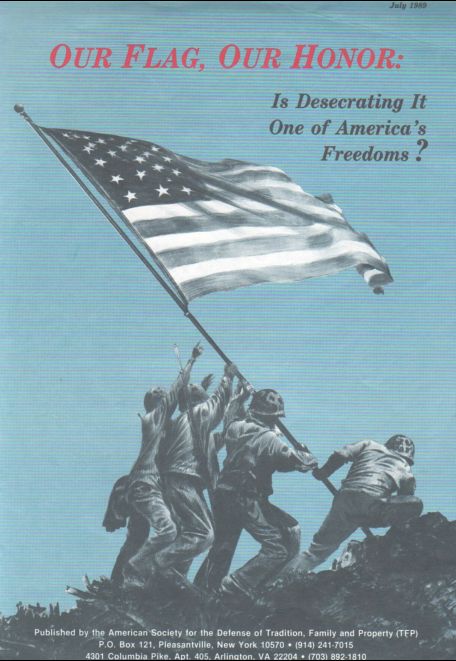
OUR IMAGINATION goes back to the Pacific Theater of the Second World War. In March 1945, the brave American marines after an arduous campaign against the Japanese troops are completing their conquest of Iwo Jima. They are now at the apex of their victory. On the heights of Mount Suribachi, our valiant soldiers raise the national flag with dedication, zeal and energy, thus announcing to all that American power has triumphed again. The scene is both heroic and serene. Our national colors flutter festively yet unpretentiously in the wind. The soldiers, in a united effort which reveals the camaraderie of hearts beating in unison, express no sign of hatred toward the vanquished. Their only desire is to firmly secure the mast of the flag they admire so much, so that future storms would not strike it down. They raise the Stars and Stripes high so that it can be clearly seen with esteem, even from afar. Our Flag Radiates the Honor and Glory of Our Country To the American people it is the splendor of our nation's glory. It is undoubtedly an affirmation of our strength: strength in defense of national honor, security and sovereignty; a robust strength, springing from our material abundance and from our regard for all nations. We equitably share this abundance with other peoples, even those just defeated and those yet to share the same fate. In the drawing on our cover, these sentiments eloquently shine forth. There is a certain spontaneity that is not ostentatious, but rather displays the radiant beauty of strength, idealism and generosity. Inspired by this event, artist Felix de Weldon crafted the U.S. Marine Corps War Memorial near Arlington National Cemetery. Showing a keen psychological sense, President Bush chose the site of this striking sculpture to launch a national campaign to defend the flag, shortly after the Supreme Court decision sanctioning the burning of it as a First Amendment "right." Americans, from the Atlantic to the Pacific, from the Great Lakes to the Rio Grande, see reflected in this flag their national pride, together with their own individual identity. For this reason, they love and praise it as one of the highest symbols of the country's moral and cultural values. Is it reasonable, is it proper that an American citizen despise it? Is it legitimate to insult it? To destroy it? How can the cold heart of such an American desecrate so lofty a symbol with impunity? Or even burn it? Doesn't this suggest that he would like to destroy the country itself? Is It among the Rights Existing in Our Country to Allow Our Honor to Be Trampled On? If an individual who possesses the means to successfully and courageously defend himself were to allow his reputation to be tarnished without protest, we would say, at the very least, that he lacks moral sensibility. To see his own dignity trampled on should make him blush with shame! In the same vein, should a nation be defiled by allowing its honor and symbols to be treated with disrespect? Is this strange license to submit to what could be called a public and arrogant sacrilege included in the body of American freedoms? Does the American Constitution Guarantee the Desecration of Our National Symbols? But our Supreme Court, to which we refer here with all due respect, saw fit to rule, in the case of one Gregory Johnson who publicly burned our glorious American flag in Texas, that the First Amendment granted him this inconceivable liberty. In so doing, the court declared this highly insulting act against our country to be beyond reprimand. Once a new generation of Americans becomes accustomed to seeing the flag disrespected and burned with this impunity, which we do not hesitate to call scandalous, it can only cause their love, respect and pride in being American, in short, their patriotism, to diminish. Excessive Justice Constitutes a Supreme Injustice: Against This an Immense National Clamor seeks a Remedy An immense national clamor is needed to call the attention of our legislative authorities to the principal aspects of this offensive act to our nation. The general principles of morals and justice are above all written law. Denying this would amount to denying the wise maxim of Roman law: "Summum jus, summa injuria" (The strict interpretation of the law may be the height of injustice, Cicero, De Officiis, I, 10). Just as those brave marines hoisted their victorious flag atop Suribachi, this national clamor must take this legal maxim to the summit in defense of the national flag, and to bring about the adoption and ratification of an amendment to the Constitution which will guarantee, beyond any doubt, the right of the American nation not to be vilified in its own land! Amend the Constitution: Save the Honor of the Flag Some might consider it inadvisable to amend the Constitution, since it is the basic legal monument on whose immutability rests the very stability of the nation itself. We respect the opinion of those who think this way. We promptly add, however, that we are not convinced by this argument because we are among those who believe the nation's stability rests less upon the unchanging nature of its laws than upon the respect, love and enthusiasm with which her children honor her. What would our Constitution's solidity and vigor be worth, we ask, in a nation where attacks against the flag and honor multiply? And in a nation where such deplorable acts, becoming ever more frequent and routine due to their very impunity, would be viewed with indifference by a population made cynical by the loss of moral sensibility? Amend the Constitution: Save the Country What would happen in those critical hours, which, as history teaches us, not even the most prosperous, generous, or strongest nations are spared, if patriotic sentiment should sink so low? What courage would be left to fight, be it in peace or war? Thus, the fate of the nation itself calls for an urgent measure to repair this breach opened by the decision of the Supreme Court, which found or supposed it found a basis for its action in the First Amendment to our Constitution. We recall, in this regard, yet another supreme principle of law which is valid for all peoples, at all times, in all places: "Salus populi, suprema lex" (The welfare of the people is the supreme law, Cicero, De Legibus, III, 9). Let Us Unite and May God Help Us In thus proclaiming its thoughts and sentiments, the American Society for the Defense of Tradition, Family and Property (TFP) cordially addresses all public figures, associations, groups or currents of opinion who have already spoken out, or plan to address this issue, in order to propose a concerted action for this high purpose. We beseech Divine Providence for Its paternal and decisive support so that the wishes of so many good Americans triumph, and so that this country retain the inalienable right not to suffer attacks against its honor.
|
|