|
Plinio Corrêa de Oliveira
“Pater, non mea voluntas, sed tua fiat”
TFP Magazine, March-April 1993 (*)
|
|
|
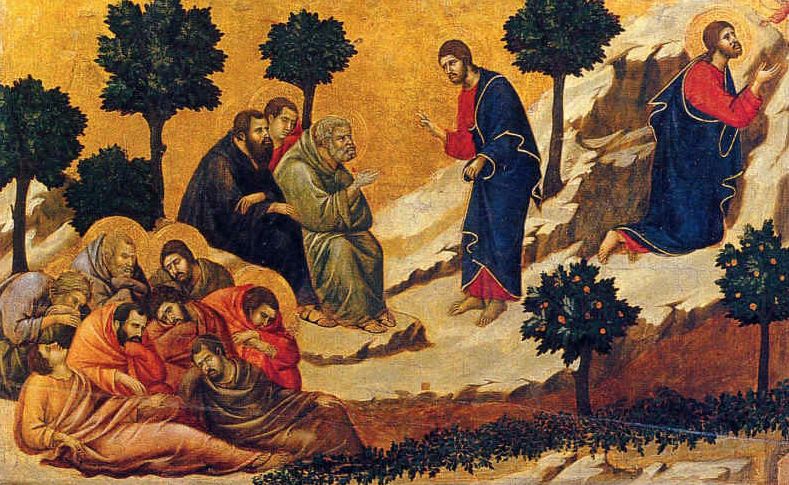
“When Jesus had said these things, He went forth with His disciples over the brook Cedron, where there was a garden, into which He entered with His disciples” (John, 18:1). Jesus went forth from Jerusalem. This was not an ordinary departure followed by a prompt return, but a true and profound separation. The Messiah loved the Holy City, its walls shrouded with glory, its Temple of the living God proudly standing therein, the Chosen People its inhabitants. It was because of this that, with special fondness, He had preached the Good News within it and contested its vices with an especially ardent vigor. But, He had been rejected. He was, therefore, leaving the accursed city. It was night. Jerusalem glittered with all its lights. There was warmth and plenty within its houses and liveliness in its streets. A great unconcern hovered over the joyful and tranquil city. About Jesus, with all His beauty, grace, wisdom, and goodness, the city was little concerned. No one noticed the moment that He left the city, no one knew it, save perhaps one or another passerby who glanced at Him with indifference. The Jews felt no need of Jesus. To guide their souls, they preferred Annas, Caiphas, and their kind. To watch over their national interests, they had Herod. They tolerated Pilate with a deeply resigned ill-humor. Under the care of these spiritual and temporal shepherds they could eat, drink, and enjoy themselves freely, then console their consciences later with a prayer or sacrifice in the Temple. Thus was everything arranged, with a somnolent and conformist outlook. Jesus had come to disturb this peace. He had spoken about death, judgment, Heaven, and Hell without understanding that the world around Him did not tolerate such preaching and that a rabbi’s first duty lay in adapting himself to the demands of the times. Endowed with a profound understanding of the Sacred Scriptures, skillful in His reasoning, adept at impressing the multitudes and in attracting people into the intimacy of His persuasive colloquies, He seemed resolved to demonstrate the irremediable incompatibility between religion on the one hand and the easygoing, unbridled, and commodious life on the other. He thus pulled on both sides of the bow and sooner or later would reduce everything to ruins. But this did not bother Him, for He was neither balanced nor reasonable. Accentuating the dangerous effect of His words, He performed miracles and, bolstered by the prestige gained thereby, He further disturbed souls by teaching that the road to Heaven is narrow, thus emphasizing the need of purity, honesty, and uprightness for gaining entry into it. Had He, who so preached mercy, no feeling for the travails of soul, the dramas of conscience He thus created? Did He, who so preached humility, not recognize the need to conform Himself with the example of prudence being given Him by the Chief Priests? It is true that at one time He seemed to be on the verge of succeeding, but the Sanhedrin had acted in time. Generously opening its coffers, it had sent emissaries amidst the multitude, raising suspicions against the insolent one. These emissaries were agile, and they knew how to strike the right psychological chords. The rabbi’s chances had been eliminated. Jerusalem would not be His. Even more! His death was agreed upon and the people would applaud it. This death was one last and insignificant corollary in the whole affair, a small matter for the police. Yes, the Jesus of Nazareth “case” was closed. The populace could once again plunge itself into pleasure, gold, and the long ceremonies in the Temple. Everything would return to normal. Yes, a great unconcern made the air seem lighter during that tranquil and satisfied night. Jesus’ preaching was over and He was leaving the city, for there was nothing for Him to do there. To associate with the tepid and drowsy tranquility of the somnolent consciences He had tried to awaken was incompatible with His perfection. The only recourse was to leave. Leave, yes, so as to express a complete estrangement, a complete separation, an undisguised incompatibility. So He departed. Left behind were the lights as He penetrated the darkness of the night. Left behind was the multitude, as He took with Him only a handful of followers. Left behind was everything of power, of wealth, of human glory as He searched for a solitary and poor place accompanied by only a few foreigners without social standing, without cultural qualifications, with nothing. Behind Him were the joys of life; He was walking towards the desolation of those who are abandoned and the terrible anguishes of those awaiting death. “And He saith to His disciples: Sit you here, while I pray” (Mark, 14:32). His isolation was greater than it would seem at first sight. The Apostles followed Him, it is true, but with their souls filled with attachment to everything they were leaving behind in this terrible separation and with dread in face of everything that their hazy perspectives of the future allowed them to foresee. Their souls no longer felt like praying: This was the beginning of their defection, since he who does not pray is tumbling headlong into the abyss. Pray? They “could not.” Return to Jerusalem? They would not. They remained there, “sitting.” And they agreed to let the Master go on further, to leave Him to Himself. The Apostles, for sure, considered themselves heroes for having remained there “sitting.” They felt their own pain so much, that they could not think about the Lord’s. They thus allowed themselves to be crushed by the suffering. Sitting. Soon they were fast asleep, and soon after they fled! Not praying, thinking little about Christ’s Passion and much about one’s own sorrows, all of this leads one to “sit down” alongside the road and let Jesus walk on. After this, there is only heaviness, slumber, lukewarmness... and flight. It is a terrible, terrible lesson for all those who set out on the long journey on the road to perfection! Jesus had warned them, “Pray, lest you enter into temptation” (Luke 22:40). They did not pray, and so they succumbed.
“And taking with Him Peter and the two sons of Zebedee, He began to grow sorrowful and to be sad.” (Matt. 26:37). A selection, as some were less dulled by the pain of abandonment, defeat, and total separation from the world. The suffering of Jesus pained them more vividly. They deserved to be called aside and to witness the beginning of the infinitely precious sorrows of the Redeemer. How many receive the same call! Grace attracts them to a greater piety, a more profound orthodoxy, a more exact understanding of the terrible situation of the Church in our days. To correspond to these graces requires the courage to participate in Our Lord’s sadness, and this requires generosity, strength, and seriousness. How does one refuse this grace? By refusing the sadness of Our Lord, dwelling on bagatelles, idolizing sports, centering one’s life on radio and television, jesting as the sole theme of one’s conversations; by fleeing from a consideration of the terrible duties our times impose and the gravity of the problems they cause, instead becoming engulfed in petty concerns of daily life. Such people do not receive the adorable trust of the sorrows of the Heart of Jesus. They are like toads, which live with their bellies hugging the earth, and not like eagles, which penetrate the highest heavens with their powerful flight. “Then He saith to them: My soul is sorrowful even unto death: stay you here, and watch with Me” (Matt. 26:38). “My soul is sorrowful,” says the Saviour, not “I am sorrowful.” He wanted to indicate that His torment was an entirely moral torment. That of His body had not yet begun. The pains of His flesh are much dwelt on in the Passion, and this is good. Nevertheless, the devotion to the Sacred Heart of Jesus came to emphasize the sorrows of His soul, and this is excellent, for sorrows of the soul are more profound, more excruciating, and more noble than those of the body; they stand in greater opposition to the defects of soul that most offend God. And with what was Christ’s soul suffering? With what should we suffer? With seeing the will of the Eternal Father violated and Jesus, Our Lord, rejected, denied, and hated. To ponder this, to measure the scope and gravity of this is to suffer within us the spiritual pains of Our Lord. Jesus Christ and His Church constitute just one whole. Every time we encounter an immoral advertisement, an unjust statement, an institution or a law opposed to the Church’s doctrine, we should suffer. If not, if for this we have neither zeal nor strength, than we are good for nothing but to remain “sitting” and, when the hour of danger arrives, to flee. “Sorrowful unto death.” In other words, a supreme sadness. The sadness of seeing God’s law violated, the Church persecuted, the glory of God denied, should be in us a supreme sadness and not just one of those emotional and ephemeral little sadnesses emanating from frivolous and impressionable souls like the ignis fatuus of swamps and cemeteries. It should not be merely a petty sadness, one only skin-deep, that does not wrench from us serious resolutions, profound zeal, effective renunciation of everything so that we live exclusively in the fight. A soul “sorrowful unto death” is not consoled with magazines, with fine clothing or restaurants, with strolls, with trifles, honest... or dishonest! It will live in the mortal sorrow of seeing God’s glory scorned and will find a palliative only, but only, in the interior life and in the apostolate. “Stay here,” that is, do not mingle with the perfidious sons of Jerusalem, nor with the lukewarm who slumber a few steps away. “Stay with me.” Yes, participate in My solitude, in My defeat, in My sorrow. And make of this your glory, your joy, your riches. “And going a little further, He fell upon His face” (Matt. 26:39). Why did He go “a little further” after having told the three Apostles to “stay with Me”? To stay with Our Lord is to stay close to Him in spirit, it is be united with Him. Staying with Him means standing with the Church with one’s whole heart, one’s whole soul, one’s whole understanding. He who in the hours of agony thinks of Our Lord and not of himself, “stays” with Him. He who thinks only about Our Lord, and not about the world, its spirit and delights, “stays” with Him. Our Lord advanced just “a little,” a “stone’s cast,” says St. Luke (22:41). Why “go further?” And why just “a little”? Our Lord wanted to be seen so as to maintain His three chosen Apostles in their fidelity. He wanted to console them and to console Himself by feeling them close by. It was necessary, however, that He “go further” because an hour of special gravity had arrived. He was going to speak with God, and God with Him. Just as in the Jewish worship the priest entered the Holy of Holies alone, so also Our Lord wished to take this first step of His Passion alone. Have we holy solitudes in our souls such as this one? Peaks upon which only God and we stand, and to which no confidant, no friend, no earthly affection climbs and to which we admit only the gaze of our spiritual director? Or are we of those souls with no reservation or nobility, open to any wind, any scrutiny, any step, like some dull public square? “He fell upon His face.” A complete humiliation, a total renunciation; this is the victim prepared for the holocaust. What preparation for prayer! When we speak with God, do we “fall upon our face” beforehand? In other words, do we approach humbly, ready to obey, desirous of renouncing everything, recognizing our worthlessness? Or do we approach with reservations, with reticence, with sore points in which God cannot ask of us a sacrifice? When we listen to the Church, do we throw ourselves face down on the ground, renouncing all of our opinions, all of our choices, so as to obey? In face of those who edify us, bringing us closer to the Church and the Pope, do we “fall upon our faces,” accepting their influence? Or do we erect barricades, set up restrictions? “Praying and saying: My Father, if it be possible, let this chalice pass from Me. Nevertheless not as I will but as Thou wilt” (Matt. 26:39). To be prostrate on the ground, but at the same time praying, with the body lying on what is most lowly, the ground, and with the soul ascending to the highest of Heaven, the throne of God! In this consists the invincibility of the true Catholic. In the apex of affliction, of humiliation, of abandonment, he has in his hands the weapon that overcomes all adversaries. How true this is for the struggles of the interior life. With no resources for finding the right path, or resisting, we pray... and we end up successfully. And how true this is in the apostolate. Are we intimidated by the impetus of the paganizing wave? Immediately we think of conceding, in which we sacrifice the accidental because it is accidental, then the secondary essentials because they are secondary, and finally that which is fundamental... “so as to avoid greater harm.” If only we knew the strength of prayer, if only we knew how to throw ourselves face down on the ground and pray, we would understand better the efficacy of our supernatural weapons, the meaning, worth, and usefulness of Christian intransigence. The Divine Saviour suffered here for the pessimists, for those who are discouraged and have no idea of the Church’s triumphant force. “Let this chalice pass from Me.” What chalice? It was the approaching atrocious, crushing, and unjust suffering that Jesus foresaw. At this moment, the Divine Master suffered for all those who sin through optimism; for all those who, confronted with the perspective of having to fight, with anguish and pain, resort to the ostrich policy and choose to imagine that “all goes well.” To foresee the pain, to prepare courageously for it, this is elevated, most elevated, virtue. And this, whether in our private lives or for the cause of the Holy Church. In this moment in which She is so warred against, let us not have the foolishness to say that all goes well. Let us recognize the gravity of the hour and let us view the threats posed by the future in a manly and Christian manner, with a resolute and confident spirit, ready to react with prayer, combativeness, and full acceptance of the sacrifice. Such was the example given us by the Divine Master. He withdrew from everyone so that, face to face with God, He could fathom the full depth of the ocean of pain and sorrow into which He was to be immersed and take a stand in face of this perspective. What stand? “If it be possible, let this chalice pass from Me. Nevertheless not as I will but as Thou wilt.” Two supplications are comprised here. In one, the God-man asks that these pains and sorrows be removed from Him “if it be possible.” In the other, He accepts them in the event they cannot be avoided. A holy attitude this, one with no theatrics or vainglory. Pain naturally provokes fear in man, and Our Lord, not only true God but true man as well, dreaded this pain. He asked, therefore, that it pass from Him “if possible.” Avoiding pain is legitimate, wise, holy. But avoiding it at any price, no! -- only “if it be possible.” “If possible.” What does this mean? It means that, if the Divine Will, in light of the humble plea of a Just One crushed by the anticipation of the pains, would show Itself compassionate by removing the suffering, let it be so. On the contrary, if removing the suffering were to introduce a change in the plans of Providence, with a diminution of God’s glory, of the good of the Church to be founded, and of souls, then it would be better to suffer everything. “If it be possible....” What a sublime conditional, unknown to our century. And because of this the whole world is in crisis, in distress, in agony. Earthly goods, wealth, glory, health, beauty, all of these are good in the measure in which we give precedence to God’s will. But, if it be necessary for us to renounce everything, because in light of this or that interior or exterior circumstance “it is not possible” to have these things without displeasing God, then let us make the complete renunciation. If all men were to think and feel this way, the world would be another! Because of the absence of this conditional -- which comprises the entirety of order and good -- civilization perishes. “Not as I will but as Thou wilt.” Upon these words rests the entire life of the Church, of souls, and of nations. Holy, sweet, hard, and terrible words that today’s man chooses not to understand. These words provide a perfect definition of obedience, of that obedience which the world, from Luther’s day until now, has hated with increasing hatred. Yes, may the will of God be done rather than mine; I will fulfill the Commandments and will not follow my own whims. I will think as the Pope thinks, even if another doctrine seems preferable to me. I will obey everyone who exercises a legitimate authority over me, for he represents God and I will therefore do his will and not mine. My Jesus, in view of this, how can one explain that Thou art called a revolutionary and that Thou didst come to bring the Revolution to the earth? After this, there is silence. The Gospels do not tell us what answer He received, nor what Jesus replied to this answer. Why say it? And with what words? More than likely, only one person on this earth saw, knew, and adored everything: Mary Most Holy, present undoubtedly in spirit and participating in everything. The matter is too elevated for us to interpret this silence, which not even the Evangelists chose to break. Let us beseech the Mediatrix of all graces that She introduce us into the recollection of the interior life and into the ineffable mysteries of this moment of silence. Jesus accepted. “And there appeared to Him an angel from Heaven, strengthening Him. And being in agony, He prayed the longer. And his sweat became as drops of blood, trickling down upon the ground” (Luke 22:43-44). Thus began the Passion. Jesus had foreseen the pain and death and had accepted them. The very foresight of the inevitable placed Him in face of an overwhelming accumulation of torments. But “an angel strengthened Him.” Yes, His humble prayer had been heard. God was giving Him strength to overcome the invincible torment, to bear the unbearable pain, to accept with conformity the unacceptable injustice. If only we understood this! The Commandments seem too heavy for us, the wind of unbridled appetites and diabolical temptations roars within us. If only we understood that this is the hour of God. If we only “prayed the longer.” If only we accepted the visit of the angel who strengthens us! Yes, because for us also, an angel always comes, so long as we pray. At times it is an interior movement of grace, or a good book, or a friend who gives us good example or good advice. But, we do not pray. As a result, we fall. In the Agony, the angel came, as a fruit of prayer. After the visit, Our Lord continued to pray. Yes, praying the harder is the secret of victory. He who prays, saves himself; he who does not pray, damns himself, St. Alphonsus Liguori used to say. And how right he was! Jesus sweat blood. The redeeming blood flowed because of the pressure of the moral sorrow. One can say that it was blood from the heart. What a magnificent theme for devotees of the Sacred Heart. Sweating blood is the utmost of pain. It is the highest pressure point of the moral suffering upon the body. One would say that Our Lord was enduring every suffering possible. Nevertheless, He had not yet taken even the first step of His Via Sacra. His martyrdom was beginning where that of others reaches its apex. How does one explain this incomparable resistance? It is because “there appeared to Him an angel from Heaven, strengthening Him,” and because “He prayed the longer.” Oh, the value of the supernatural! And we dare say that we capitulate in the interior life or in the struggles of the apostolate from lack of strength! Three times did Our Lord present his ”fiat” (cf. Matt. 26:39-44), returning to His disciples after each time. After the first, “He found them sleeping” (Matt. 26:40), and He advised them, “Watch ye, and pray that ye enter not into temptation. The spirit indeed is willing, but the flesh is weak” (Matt. 26:41). But they paid no heed. Why? They were drowsy. Theirs was a somnolence stemming from two opposite excesses. On the one hand, despair, on the other, presumption. -- Despair: Faced with the human defeat of Jesus, their dreams of worldly grandeur were undone. What was left them? Only that darkness, that solitude, that hard and ordinary ground on which they rested. Their careers were cut short, O sorrow of sorrows! Under the burden of this sorrow, the only thing to do was sleep. -- Presumption: Nevertheless, they considered themselves strong. They had fought so much; certainly it was an insult to doubt their strength. Convinced of their resistance, unconcerned with their perseverance, they “killed time” by sleeping. It was a sleep that was rude as well. The Lord suffered and they slept! What could they care about the Lord? Were they not already rendering Him an infinite favor by being there with Him in that abandonment? What else did He want? For them to pray at so late an hour? By no means. He could watch if He wanted to. As for the Apostles, they were going to sleep. The more one enters into sleep the heavier it becomes. Such also is the progress of lukewarmness. The second time, Jesus “found them sleeping, for their eyes were heavy with sleep” (Matt. 26:42), a sleep of mediocrity, of indolence, of softness. Did they still follow the Master? Yes and no. Yes, because after all, they were there. No, because they no longer listened to Him. He would speak and they would disobey. He would suffer and they would sleep. It was the beginning of a rupture. How do such disastrous falls occur? To sleep while Jesus speaks is, for me, to be inattentive, indifferent, lukewarm when I am spoken to by those who represent the Holy Church, by those who would guide me along the ways of sanctity, by those who personify for me -- because of their example -- orthodoxy, generosity, hunger and thirst of virtue. When I fall into this sleep, what remedy is there, except to wake up, “watching and praying lest I fall into temptation?” And if I do not do so, what is the outcome? The result is failure in one’s spiritual life and in one’s vocation. The third time, Our Lord’s words are a rebuke: “Sleep ye now and take your rest; behold the hour is at hand, and the Son of man shall be betrayed into the hands of sinners. Rise, let us go: Behold he is at hand that will betray Me” (Matt. 26:45-46). It was past the hour. Not even the affectionate and doleful supplication, “couldest thou not watch one hour?” (Mark 14:37) had moved them. Shortly thereafter, “while he was yet speaking, cometh Judas Iscariot, one of the twelve: and with him a great multitude with swords and staves” (Mark, 14:43). And soon afterwards, “his disciples leaving Him, all fled away” (Mark 14:50). Yes, they fled, for they had been lukewarm, had slept, and had not prayed. If I, Lord, do not wish to flee, I must be steadfast, I cannot sleep, I must pray. Grant me, Lord, this grace of perseverance in every situation, every anguish, every bitterness; this grace of fidelity in every abandonment, every forsaking, every defeat; this grace of constancy even when all have abandoned Thee, oppressed by sleep or maddened by concupiscence for the things of this world. Otherwise, my God, take me from this life, for there is one thing I do not want, that is, to flee. Through the omnipotent intercession of Thy Most Holy Mother, Lord Jesus, this is the grace of perseverance I beseech of Thee. (*) Translated from “Catolicismo”, April 1954.
|
|