|
Plinio Corrêa de Oliveira
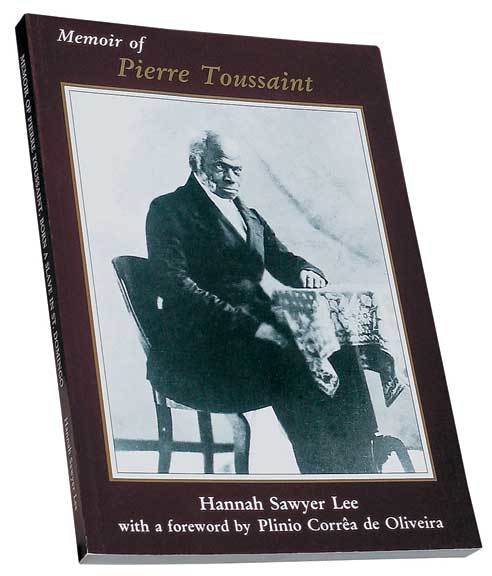
Memoir of Pierre Toussaint
Foreword
|
|
|
Memoir of Pierre Toussaint, Born a Slave in St. Domingo, by Hannah Sawyer Lee, Western Hemisphere Cultural Society, Second revised edition, Penn., 1992
The present biography of Pierre Toussaint appears at a good time in the United States. His person, which in times past enjoyed deserving distinction in New York City, where he exercised the profession of hairdresser for ladies, has vanished from the memory of New Yorkers with the passing of generations, due to the dizzying pace of activities in that immense American city. But the examples he left during his life deserve to be remembered, for they bring about profound moral and social reflections for all times. These are highly opportune for our days. The time in which Toussaint lived (1766-1853) was shaken, precisely like our own, by violent international events. The fundamentally atheistic French Revolution, which erupted in France in 1789 during the reign of the apathetic and indolent Louis XVI, has been deservingly qualified as the precursor of communism. This Revolution spread throughout France in a violent way and then spread to several European countries. In 1794, when the appalling phase of the Terror came to an end, many hoped that the Old Continent would return to its former tranquility. Such did not happen. The Revolution, ceasing to be directly destructive on the material plane of facts, did not thereby cease to exist and spread itself more and more throughout Europe and elsewhere in the ideological field. In fact, the successive regimes of the Directory (1795), the Consulate (1799), and the Empire (1804-1815) were nothing but metamorphosed forms of the French Revolution. They were inspired by the same erroneous principles and consumed by the same desire to preach these errors to the whole world. Even when Napoleon, proclaiming himself emperor of the French, crowned himself in the church of Notre Dame in Paris (1804), his counterfeit monarchical regime was nothing but another metamorphosis of the French Revolution. In fact, the order of things he imposed in France, peaceful in appearance, was nothing but the consolidation of the subversive modifications that the revolutionaries of 1789 had introduced into that country. On the other hand, wars of conquest waged throughout all of Europe, extending from Lisbon to Moscow and producing disturbances from Stockholm to Naples, enabled the emperor to impose revolutionary laws wherever he went, thus subverting the old order in the name of the principles of liberty, equality and fraternity. These principles, understood in the manner of the French revolutionaries, were nothing but antecedents of communism. For this reason, they were severely condemned by Pope Pius VI in the Secret Consistory of June 17, 1793. In this he said, confirming the words of his encyclical Inscrutabile Divinae Sapientiae, of December 25, 1775: "These accursed philosophers proceed to destroy the bonds of union among men, both those which unite them to their rulers, and those which urge them to their duty. They cry ad nauseam that man is born free and subject to the authority of no one, that society accordingly is a crowd of foolish men who stupidly yield to priests who deceive them and to kings who oppress them, so that the necessary concord between the priesthood and the civil power is only a monstrous conspiracy against the innate liberty of man [encyclical Inscrutabile Divinae Sapientiae]. "To the false and lying name of liberty these vaunted patrons of the human race add another deceitful name, equality; as though among men who have formed a civil society with so many diverse affections, uncertain inclinations, subject to the caprice of each, there was to arise no one to prevail by authority and power, who could constrain, moderate, and recall the wicked to the bounds of right. Without this, such a society, swayed by rash impetuosity and the clash of so many conflicting desires, falls into anarchy, and cannot escape a speedy dissolution: it is then with society as with harmony, when composed of the accord of various sounds. But if it has not, as a soul, a suitable accord of chords and voices, it produces only troubled noises and deafening dissonance" (Pius VI, Pont. Max. Acta [Rome: Typis S. Congreg. de Propaganda Fide, 1871], vol. 2, pp. 26-27). * * * These events not only shook Europe, but had harmful repercussion in the New World as well. France at that time was mistress of the islands of Martinique, Guadeloupe, and Saint Domingue (present-day Haiti). These Caribbean possessions, until then prosperous and tranquil, deeply suffered the disturbances of the French Revolution. The slaves and the mestizos rose up against their masters and employers with the intention of shaking off their yoke, just as the nobility had been suppressed in the mother country. Among the prosperous families of Saint Domingue was that of Jean Bérard du Pithon. Pierre Toussaint, a black, was one of his slaves. Pierre was only 21 years old when the disturbances of the Revolution led the family to take refuge in New York. Toussaint accompanied them, and thence his story truly begins. The family, belonging to the nobility, was able at first to live well in New York with the savings they brought with them. Like many of the French emigrants after the fall of the Bastille (1789) in Paris, who left the country with a fixed amount of money and the certainty that the Revolution would not last long, the Bérard du Pithon family also expected a quick return to their homeland, judging that the revolution in Saint Domingue would be short-lived. Many so deceived themselves and, depleting their financial resources, soon faced dire circumstances. The Bérard family, then, had to reduce considerably the level of its social status, feeling threatened to resort to jobs incompatible with their condition in order to live. It was in this sad predicament, after eleven years of happy association, that Monsieur Jean Bérard died in 1791, leaving the aristocratic Marie Elisabeth Bossard Roudanes a widow. She had to confront the adverse conditions alone and, moreover, in precarious health. But the hand of Providence watched over her. The "hand of Providence": a beautiful metaphor to characterize the watchfulness with which God accompanies and aids the lives of His creatures. Religious art customarily presents it as a charitable white hand; in this concrete case, the "hand of Providence" was a black hand: the hand of Pierre Toussaint. This modest slave, who could so easily have tried to escape from the yoke of his mistress in the United States, acted in relation to her with a dedication and a delicacy of sentiment that few children have even in relation to their own mother. After completing a schedule of duties that required great selflessness and that he fulfilled to the end, Pierre Toussaint, by his own decision, strove even more in order that his mistress would not want for anything of the social conditions and comforts of life that corresponded to the education she had received. At the suggestion of his deceased master, Pierre had learned the skills to practice the art of dressing ladies' hair in the small but already rich New York of that time. Imaginative and gifted with good taste, he developed various hairstyles that were much to the liking of his affluent clients, who then paid him well for his services. In a short time, Toussaint came to be sought out by all the rich ladies of New York, and he thus obtained the necessary resources to support his mistress. However, he accomplished this with such skill and discretion that he was often able to hide from her a good part of his self-denial and generosity. He did this without lying, because Toussaint was very truthful and, as a fervent Catholic, he avoided any transgression of the Commandments of the Law of God. Very early in the morning, before beginning his work, Toussaint could be seen going to Saint Peter's Church on Barclay Street where every day for sixty years he attended Holy Mass (daily Communion becoming a custom of fervent Catholics only after the pontificate of Saint Pius X [1904-1914]) and prayed his rosary. Only after this did he begin his professional activities. With the conditions created by Toussaint, Madame Bérard's shaken health slowly recovered and, with his encouragement, she could once again open her parlors to guests. Toussaint, having labored during the day as a hairdresser, worked gratuitously at night as a butler. Superbly dressed, with very gentle and pleasant manners, he served all his mistress's guests, and then delighted them with his violin, which he played excellently. In time, a French refugee named Gabriel Nicolas, a skilled musician whose talent provided him a well-to-do life in New York, obtained the hand of the widow Bérard, who thus became Madame Nicolas. Although relieved for some time with the new marriage, this fortune returned to visit the noble lady. Due to the passing of an abstruse law, several New York theaters were closed and, with this, the main source of her husband's income disappeared. Toussaint's faithfulness was once again her support. His work with the ladies of the high society of New York continued and he exercised a beneficent influence. During the work they talked about various subjects, and in everything he answered with so much correctness and made such wise commentaries that many regarded him as a counselor, asking his opinion about delicate personal problems. Some even went to his home when, surprised by some new problem, they urgently needed a judicious solution from Toussaint. As one can imagine, Toussaint accumulated some savings. With this, he could have acquired his own freedom, but, ever a model in his self-denial, he preferred to remain in his condition as a slave and buy instead the freedom of his sister, who had come with him from Saint Domingue, and that of his future wife! Toussaint only acquired his own freedom much later, in 1807 at age 41. In July of that year, shortly before dying, Madame Nicolas made it a point to grant Toussaint's freedom, in agreement with her husband. In 1811, Toussaint married. Without ceasing to render services to Monsieur Nicolas as long as he remained in New York, Pierre established his own home. He was a model husband. The death of his wife in 1851, two years before his own, was a moral blow to Toussaint from which he never fully recovered. From then on his previously flourishing health began to deteriorate. This provides a measure of the richness of Toussaint's sentiments. This richness of sentiments almost reaches the unimaginable. A part of the Bérard family had scattered in Europe with the French Revolution. Afterward, when the Terror ended and the emigrants began to return, Toussaint made efforts to know if these loved ones had survived and, if so, where and how. What was his contentment when, through a French lady who passed through New York and whom Toussaint attended, he found out that Aurora Bérard, his old master's sister and his godmother in Baptism, had not died as he had supposed but lived in Paris. She wrote her first letter to her godson as soon as she learned about him. Toussaint answered this letter and sent with it a dozen Madras handkerchiefs, highly esteemed by the French ladies of the time. Toussaint kept up a long correspondence with his godmother that ceased only with her death in 1834. One of her brothers, also living in France, was the object of Toussaint's epistolary watchfulness as well. As one can see, a more exemplary dedication cannot be imagined. * * * But the life of all men is shaken by violent winds and these were not lacking in Toussaint's life. One was the brusque change in women's hairstyles, which became much more simple. His professional services became practically unnecessary to his affluent clients. This could have meant a complete ruin for Toussaint. However, being very skillful and able in everything, he did not let himself be discouraged. He adapted to the new styles and maintained his clientele, who now used his services more as a pretext for obtaining his daily visit and pleasant conversation. These facts constitute a true epic of dedication of a Catholic soul to his family as well as to his masters. It is an epic accomplished in such a dedicated manner and with such brilliance that Toussaint's life reads like an innocent but highly attractive novel. Nevertheless, his life contains many more elements to properly attract our attention and serve as a theme for high reflections of a moral character. The reader will find all this by carefully reading and reflecting on this biography published by the Western Hemisphere Cultural Society. We sincerely counsel you to do so. A capital reflection, meanwhile, presents itself to our eyes. It is the fulgurant antithesis between Toussaint and the radical modern egalitarianism of which communism was a characteristic example. Having been born into the hard conditions of slavery and faced while still quite young by the flames of a social revolution full of incitement to revolt against his owners, Toussaint would have had easy means for freeing himself from this yoke. It would have been enough for him to have adhered to the revolutionary movement that a namesake of his, Toussaint L'Ouverture, successfully headed for a long time. Toussaint L'Ouverture was a little prefigure of the so-censurable Fidel Castro who has led a social and political revolution in Cuba to the last extremes. After thirty years of cruel dictatorship, Castro still holds the population of this island, formerly evangelized by the great Saint Anthony Mary Claret and deservedly called, due to its natural beauty, the Pearl of the Antilles, in misery and under the iron-grip of a true captivity. While communism, on the one hand, is atheistic, Toussaint was the model of a believing and pious man. He adhered, as we have already said, to all of the Roman Catholic and Apostolic doctrine and fervently fulfilled the Commandments. While the communist revolution is fundamentally egalitarian and preaches hatred against all superiors, Toussaint was the paradigm of a man with hierarchical spirit and love for his superiors, as the Fourth Commandment enjoins: "Honor thy father and thy mother." And while communism's cry of revolt could be perfectly condensed in Satan's exclamation of revolt, "Non serviam," Toussaint's life, on the contrary, is summarízed in this word that would be worthy of Saint Michael the Archangel: "serviam." He served. He served his family members; he served his masters; he served his clients; he served everyone to whom he could do good; and he did so with largess and generosity. The one he least served was himself. The ferocious egoism that Marx sought to incite in each one of his followers was precisely the contrary of the abnegated and generous spirit of Toussaint. Thus, Toussaint seems to us as a man who, although of little learning, nevertheless understood the spirit of the Catholic Church so well that, in face of the phenomenon of social inequalities, he entirely accepted the doctrine of the Angelic Doctor, Saint Thomas Aquinas. In very summarized form, this doctrine is that harmonious and judicious inequalities are not evil, but, on the contrary, are good. They are a condition of order on earth as in heaven. The great Doctor of the Church says that God, upon undertaking the creation of the universe, was necessarily moved by the intention of making the universe a reflection of His own perfections, but that, these perfections being multiple and infinite, there was not a single creature that could reflect them all at the same time. For this reason, He gave being to several creatures, each fitted with the duty of reflecting an aspect of His perfection. Furthermore, the perfections have several degrees in creatures. It is through graduated perfections that creatures best reflect the absolute perfection, which is God. This being so, men, in turn, and angels as well, were created unequal. This inequality is a condition for them to adequately reflect God. Saint Thomas Aquinas thus affirms in the Summa Theologica: "In natural things species are arranged in degrees; as the mixed things are more perfect than the elements, and plants than minerals, and animals than plants, and men than other animals; and in each of these one species is more perfect than others. Therefore, as the divine wisdom is the cause of the distinction of things for the sake of the perfection of the universe, so is it the cause of inequality. For the universe would not be perfect if only one grade of goodness were found in things" (Summa Theologica, I, q. 47, a. 2). Thus, creatures are necessarily multiple. And not only multiple, but also necessarily unequal. This is the doctrine of the Holy Doctor: "Furthermore, a plurality of goods is better than a single finite good, since they contain the latter and more besides. But all goodness possessed by creatures is finite, falling short of the infinite goodness of God. Hence, the universe of creatures is more perfect if there are many grades of things than if there were but one. Now it befits the supreme good to make what is best. It was therefore fitting that God should make many grades of creatures. "Again, the good of the species is greater than the good of the individual, just as the formal exceeds that which is material. Hence, a multiplicity of species adds more to the goodness of the universe than a multiplicity of individuals in one species. It therefore pertains to the perfection of the universe that there be not only many individuals, but that there be also diverse species of things, and, consequently, diverse grades in things" (Summa Contra Gentiles, bk. 2, chap. 45). Intrinsically, therefore, inequality is not an evil. It is a good. And absolute equality, on the contrary, is an evil. It was because they turned to this absolute equality that the rebellious angels rose up against God, when He revealed to them the Incarnation of the Word, and the superiority that Our Lord Jesus Christ would, therefore, have over them. On the contrary, Saint Michael the Archangel, resisting Satan's cry of revolt, proclaimed the holiness and the perfection of a fundamentally unequal universe as is that of the angels. This is a profound and admirable lesson for modern men, who, in their great majority, are so often imbued with the spirit of complete equality, even when not practicing it in their actions, and who so often revolt against those to whom they owe love, respect, and obedience: parents, teachers, employers, and others in positions of authority in the political, social, and economic spheres. Well understood, this apologia of inequality does not include the praising of unjust inequalities. Regarding the rights inherent to human nature—those belonging to all men as men—all are equal, because all are men. But, to the extent that men are accidentally unequal, it is necessary to respect these inequalities, to love them and serve them. This is the great lesson we receive from Pierre Toussaint. We recommend all readers of this work to meditate on and imitate this lesson. In America, where racial strife has so often brought lamentable discord and division, this grand example, who helps Catholics revere a black so worthy of all their respect and love, contributed to the eradication of mutual discord and distrust between the races and, thus, to the consolidation of concord among all Americans. * * * In short, Toussaint's life was a remote, but luminous, reflection, of the precept uttered by Saint Peter, who ordered the slaves of his time to obey their masters, not only when they are worthy of respect and affection like Madame Bérard, but even when they are harsh: "Servants, be subject to your masters with all fear, not only to the good and gentle, but also to the harsh" (1 Pet. 2:18).
|
|